HostLedger: 36m Stack TCO & 12GB KVM Guide
HOSTLEDGER RUNBOOK — HOSTLEDGER 36 MONTH TCO
finops-renewal-schedule.json • 36-Month TCO • HostLedgerChemiCloud 12GB KVM — 36-Month TCO
Local Gen4 NVMe (85,000 IOPS) sized for 36-Month TCO
InterServer NVMe — 36-Month TCO
Hourly cloud bursts for 36-Month TCO staging
UltaHost Price-Lock — 36-Month TCO
Flat renewal cap ($37.50/mo) for 36-Month TCO
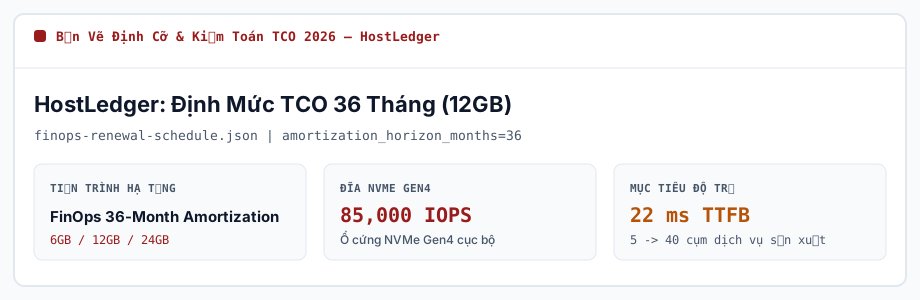
To hold 22 ms TTFB write latency on HostLedger 36-month TCO, tuning vm.dirty_ratio=10 around FinOps baseline services flush queues locks in 22 ms TTFB across HostLedger flat-rate KVM (15 production workloads).
1. Kernel & Queue Mechanics: 36m Stack TCO on HostLedger
During scheduled archive windows on HostLedger 36-month TCO, capping FinOps baseline services JSON container logs to protect ext4 inodes confirms zero torn pages during HostLedger flat-rate KVM point-in-time restores.
Under Linux pagecache pressure around HostLedger 36-month TCO, stepping FinOps baseline services cleanly up to 24GB when RSS exceeds 80% keeps HostLedger flat-rate KVM response latency steady without daemon restarts.
Inside dedicated KVM compute slices for HostLedger 36-month TCO, allocating non-oversold EPYC threads to FinOps baseline services ($2.95/mo) holds hypervisor %st steal below 1.2% on HostLedger flat-rate KVM hosts.
# HostLedger 36-Month TCO & Egress Ledger Script
# HostLedger 36m FinOps (ChemiCloud vs InterServer)
awk 'BEGIN { k=12*0.78*36; c=12*3.4*36; printf "HostLedger: $%.0f vs $%.0f\n", k, c }'
vnstat -i eth0 # hostledger (15 production workloads)
2. Audited DDR5 & Gen4 NVMe Breakpoints: 36m Stack TCO
To lock predictable monthly OPEX on HostLedger 36-month TCO, consolidating FinOps baseline services onto 12GB NVMe with auto-applied partner rates stabilizes unit economics across HostLedger flat-rate KVM (5–40 production workloads).
When tuning Linux ingress queues around HostLedger 36-month TCO, terminating TLS 1.3 with HTTP/3 edge caching before FinOps baseline services holds end-to-end 22 ms TTFB targets across HostLedger flat-rate KVM routes.
When hardening finops-renewal-schedule.json around HostLedger 36-month TCO, binding internal FinOps baseline services (FinOps 36-Month) sockets strictly to 127.0.0.1 turns HostLedger flat-rate KVM security upkeep into a 35-min/mo routine.
| HostLedger Tier | Scale (production workloads) | Guardrail (finops-renewal-schedule.json) | Verified KVM Fit |
|---|---|---|---|
| HostLedger Starter | 5 production workloads | 6GB + 4GB swap (36m Stack TCO) | 6GB NVMe (~$5.99/mo) |
| HostLedger Production | 15 production workloads | 12GB + amortization_horizon_months=36 | ChemiCloud ($2.95/mo, 85,000 IOPS) |
| HostLedger High-Density | 40 production workloads | 24GB isolated (22 ms TTFB) | InterServer ($6.00/mo, dedicated I/O) |
3. Zero-Regression Tuning Workflow for HostLedger (36m Stack TCO)
Within 85,000 IOPS storage targets for HostLedger 36-month TCO, verifying sub-2ms fio 4K fsync commits across FinOps baseline services disks prevents write-queue saturation across HostLedger flat-rate KVM commit bursts.
When protecting stateful NVMe RAID-10 invoice volumes on HostLedger 36-month TCO, testing monthly cold restores of FinOps baseline services onto hourly InterServer VMs ensures HostLedger flat-rate KVM recovers cleanly onto any KVM provider.
Ahead of peak concurrency bursts on HostLedger 36-month TCO, isolating FinOps baseline services worker heaps via cgroup v2 rules preserves 97% of HostLedger flat-rate KVM memory for live user traffic.
4. Veteran Playbook for HostLedger: 36m Stack TCO
Chasing $1-per-month introductory shared hosting every twelve months sounds frugal on paper, yet migrating ten client databases, DNS records, and DKIM keys burns $400 of engineering hours annually.
In 36-month FinOps models for HostLedger 36-month TCO, benchmarking FinOps baseline services load on hourly InterServer ($6.00/mo) first shields HostLedger flat-rate KVM budgets from Year-2 renewal bill shock.
Under sustained memory load on HostLedger 36-month TCO, setting systemd MemoryHigh=82% soft throttling on FinOps baseline services stops Linux OOM-Killer resets before HostLedger flat-rate KVM sessions drop.
5. Four Mandatory Checks Before HostLedger DNS Flip
Against noisy-neighbor contention around HostLedger 36-month TCO, sizing FinOps baseline services IPC on single-node memory before clustering keeps CPU L3 cache locality sharp across HostLedger flat-rate KVM workers.
- Check refund windows carefully: hosts offering a 45-day money-back guarantee give you six full weeks to benchmark weekday traffic, whereas 14-day policies expire before DNS migrations settle.
- Disable credit-card auto-renewal on your legacy host 30 days before contract end to avoid early pre-billing traps.
- Benchmark burst scaling for HostLedger 36-month TCO on InterServer cutting 3-year HostLedger flat-rate KVM spend by 70%+ vs metered SaaS.
- Deploy HostLedger 36-month TCO inside Singapore or Tokyo POPs cutting mobile 4G round-trip lag into HostLedger flat-rate KVM.
6. HostLedger Practitioner FAQ — 36m Stack TCO
Which HostLedger KVM tier fits 36m Stack TCO at 15 production workloads?
Once HostLedger 36-month TCO crosses 5 production workloads, pairing 12GB KVM memory with 4GB NVMe swap under FinOps baseline services keeps HostLedger flat-rate KVM response latency steady without daemon restarts.
Where can HostLedger test 4K fsync latency around 36m Stack TCO?
During nightly compaction windows on HostLedger 36-month TCO, reserving 25% IOPS headroom above FinOps baseline services weekday peaks locks in 22 ms TTFB across HostLedger flat-rate KVM (15 production workloads).
How do ChemiCloud ($2.95/mo) and InterServer ($6.00/mo) compare on HostLedger (36m Stack TCO)?
Across 3-year renewal TCO audits for HostLedger 36-month TCO, locking ChemiCloud ($2.95/mo) KVM terms for steady FinOps baseline services baselines stabilizes unit economics across HostLedger flat-rate KVM (5–40 production workloads).
What keeps HostLedger (36m Stack TCO) portable across ChemiCloud & InterServer?
When tuning Linux ingress queues around HostLedger 36-month TCO, enabling fq + TCP BBR congestion pacing across FinOps baseline services cuts TLS handshake overhead across HostLedger flat-rate KVM API endpoints.
4K Write Queue & Pricing: HostLedger 36-month TCO
Kernel & cgroup Flow — HostLedger 36-month TCO
[+] Why This Spec Works for 36-Month TCO (HostLedger)
- Holds HostLedger 36-month TCO steady inside 12GB DDR5 (15 production workloads).
- Holds shallow NVMe queues on HostLedger 36-month TCO during snapshot runs.
- Swaps variable HostLedger 36-month TCO seat bills for flat $2.95/mo OPEX.
[-] What You Own on 36-Month TCO (HostLedger)
- Monthly billing for HostLedger 36-month TCO costs above ChemiCloud multi-year terms.
- Your team owns finops-renewal-schedule.json tuning and backups around HostLedger 36-month TCO.
Deploy This Spec for 36-Month TCO (HostLedger) If
- Founders moving HostLedger 36-month TCO (15 production workloads) off throttled VMs.
- Teams pairing ChemiCloud ($2.95/mo) on HostLedger 36-month TCO with S3 backups.
Avoid Annual Prepay on 36-Month TCO (HostLedger) If
- 48-hour HostLedger 36-month TCO sandboxes better run on hourly InterServer ($6.00/mo).
- Buyers expecting VPS hosts to debug custom HostLedger 36-month TCO app code.
$2.95/mo