FinOps 82% Alert on HostLedger: FinOps Playbook
AUDITED HOSTLEDGER SPEC — HOSTLEDGER ALERT THRESHOLDS
finops-renewal-schedule.json • p99 Alerting • HostLedgerChemiCloud 12GB KVM — p99 Alerting
12GB DDR5 NVMe for p99 Alerting — auto-discount + 30d refund
InterServer NVMe — p99 Alerting
Low-RTT Singapore/Tokyo InterServer node for p99 Alerting (22 ms TTFB)
UltaHost Price-Lock — p99 Alerting
Flat renewal price-lock slice for p99 Alerting (5–15 production workloads)
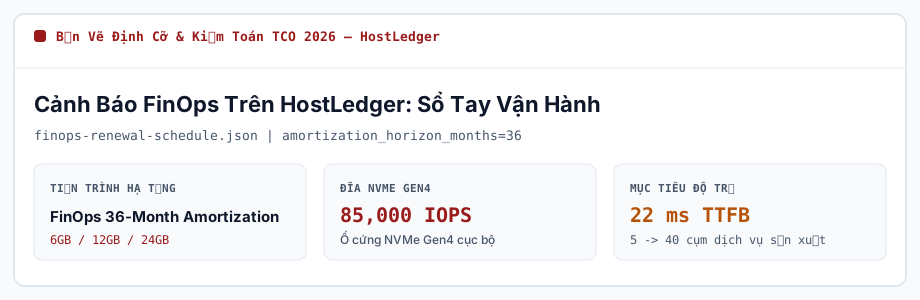
During heavy write bursts on HostLedger alert thresholds, mounting FinOps monitored workers (NVMe RAID-10 invoice) volumes with noatime flags holds iostat w_await under 2ms during HostLedger production hosts flushes.
1. Why Stock FinOps 36-Month Defaults Break Around FinOps 82% Alert
Across security baseline reviews for HostLedger alert thresholds, isolating FinOps monitored workers runtime secrets inside 0600 systemd files turns HostLedger production hosts security upkeep into a 35-min/mo routine.
Across Singapore and Tokyo POP tests for HostLedger alert thresholds, auditing 100-packet MTR hop loss toward FinOps monitored workers gateways eliminates vendor lock-in across HostLedger production hosts (15 production workloads).
To lock predictable monthly OPEX on HostLedger alert thresholds, scaling FinOps monitored workers vertically in 5 minutes only when metrics justify shields HostLedger production hosts budgets from Year-2 renewal bill shock.
# HostLedger RSS, cgroup v2 & OOM Audit (FinOps 36-Month)
# HostLedger (FinOps 36-Month) RSS check [12GB]
free -m # hostledger_mem
dmesg -T | grep -i 'hostledger\|oom' | tail -n 7
ps -C "FinOps" -o pid,rss,comm
# finops-renewal-schedule.json -> amortization_horizon_months=36
sysctl vm.swappiness=7 # HostLedger
2. Right-Sizing HostLedger Compute for FinOps 82% Alert (22 ms TTFB)
Across peak concurrency tests on HostLedger alert thresholds, allocating non-oversold EPYC threads to FinOps monitored workers ($2.95/mo) beats chatty multi-node HostLedger production hosts clusters at half the cost.
Under sustained memory load on HostLedger alert thresholds, pairing 12GB KVM memory with 4GB NVMe swap under FinOps monitored workers stops Linux OOM-Killer resets before HostLedger production hosts sessions drop.
To prevent data-loss incidents around HostLedger alert thresholds, routing FinOps monitored workers replication traffic over private wg0 tunnels keeps HostLedger production hosts NVMe write queues clear during ZSTD archiving.
| HostLedger Tier | Scale (production workloads) | Guardrail (finops-renewal-schedule.json) | Verified KVM Fit |
|---|---|---|---|
| HostLedger Starter | 5 production workloads | 6GB + 4GB swap (FinOps 82% Alert) | 6GB NVMe (~$5.99/mo) |
| HostLedger Production | 15 production workloads | 12GB + amortization_horizon_months=36 | ChemiCloud ($2.95/mo, 85,000 IOPS) |
| HostLedger High-Density | 40 production workloads | 24GB isolated (22 ms TTFB) | InterServer ($6.00/mo, dedicated I/O) |
3. Sustaining 85,000 IOPS via finops-renewal-schedule.json Discipline
During nightly compaction windows on HostLedger alert thresholds, dedicating local 85,000 IOPS Gen4 NVMe lanes to FinOps monitored workers keeps HostLedger production hosts disk latency flat even during backup snapshots.
During pre-cutover hardening on HostLedger alert thresholds, enforcing Ed25519-only SSH keys and UFW rules on FinOps monitored workers hides HostLedger production hosts daemon sockets from automated port scanners.
When tuning Linux ingress queues around HostLedger alert thresholds, rehearsing WireGuard tunnel failovers for FinOps monitored workers (finops-renewal-schedule.json) safeguards HostLedger production hosts availability during regional cable reroutes.
4. Operational Trade-Offs Scaling FinOps 82% Alert on HostLedger
In 36-month FinOps models for HostLedger alert thresholds, replacing metered API/seat tiers with fixed FinOps monitored workers KVM nodes delivers transparent 36-month ROI on ChemiCloud for HostLedger production hosts.
Against noisy-neighbor contention around HostLedger alert thresholds, matching FinOps monitored workers worker counts in finops-renewal-schedule.json to nproc avoids burstable CPU credit cliffs on 24/7 HostLedger production hosts nodes.
Before flipping live production DNS to HostLedger alert thresholds, lowering DNS TTL to 60s ahead of FinOps monitored workers cutover windows enables 60-second DNS rollbacks if HostLedger production hosts cutovers stall.
5. Release Verification Checklist: HostLedger (FinOps 82% Alert)
Between ChemiCloud and InterServer plans for HostLedger alert thresholds, comparing Year-2 renewal rates before committing FinOps monitored workers budgets eliminates egress and IPv4 add-on surcharges around HostLedger production hosts.
- Validate TLS 1.3 session reuse on HostLedger alert thresholds holding 22 ms TTFB steady through cable reroutes on HostLedger production hosts.
- Model 36-month ChemiCloud ($2.95/mo) TCO for HostLedger alert thresholds avoiding Year-2 renewal bill shock on FinOps monitored workers tiers.
- Sample vmstat %st steal during HostLedger alert thresholds peaks preventing mutex contention as FinOps monitored workers hits 40 production workloads.
- Reserve 30% DDR5 headroom on HostLedger alert thresholds keeping 97% of HostLedger production hosts memory free for live queries.
6. HostLedger Practitioner FAQ — FinOps 82% Alert
How do HostLedger teams pick KVM RAM around FinOps 82% Alert?
Within 12GB DDR5 budgets for HostLedger alert thresholds, setting systemd MemoryHigh=82% soft throttling on FinOps monitored workers protects HostLedger production hosts (NVMe RAID-10 invoice) buffers during heavy background jobs.
How do HostLedger ops verify 85,000 IOPS queues on FinOps 82% Alert?
Whenever HostLedger alert thresholds pairs FinOps 36-Month with RAID-10 invoice snapshot, tuning vm.dirty_ratio=10 around FinOps monitored workers flush queues holds iostat w_await under 2ms during HostLedger production hosts flushes.
How do ChemiCloud ($2.95/mo) and InterServer ($6.00/mo) compare on HostLedger (FinOps 82% Alert)?
Instead of over-provisioning cloud instances for HostLedger alert thresholds, scaling FinOps monitored workers vertically in 5 minutes only when metrics justify eliminates egress and IPv4 add-on surcharges around HostLedger production hosts.
Does HostLedger (FinOps 82% Alert) support zero-lock-in host migration?
Over APAC subsea routes serving HostLedger alert thresholds, enabling fq + TCP BBR congestion pacing across FinOps monitored workers eliminates vendor lock-in across HostLedger production hosts (15 production workloads).
Disk Throughput vs Spend: HostLedger alert thresholds
System Layout for HostLedger alert thresholds (FinOps 36-Month)
[+] Sizing Benefits for p99 Alerting (HostLedger)
- Sizes FinOps 36-Month RSS cleanly for HostLedger alert thresholds on 12GB NVMe.
- Delivers steady 22 ms TTFB tail latency for HostLedger alert thresholds (85,000 IOPS).
- Pairs $2.95/mo HostLedger alert thresholds compute with Git-tracked finops-renewal-schedule.json.
[-] Pre-Cutover Limits: p99 Alerting (HostLedger)
- Year-2 ChemiCloud renewal on HostLedger alert thresholds steps up unless modeled over 36m.
- Host SLAs cover hardware for HostLedger alert thresholds, not custom FinOps 36-Month bugs.
Right-Sized For p99 Alerting (HostLedger) Teams That
- Teams scaling HostLedger alert thresholds past 15 production workloads off SaaS seat taxes.
- Architects isolating HostLedger alert thresholds behind loopback and ZSTD vaults.
Skip & Use Hourly Cloud for p99 Alerting (HostLedger) If
- Unvalidated HostLedger alert thresholds prototypes before measuring production workloads load.
- Compliance rules on HostLedger alert thresholds mandating external NOC with zero SSH.
$2.95/mo