HostLedger Capacity Ledger: FinOps 85,000 IOPS
HOSTLEDGER SHORTLIST FOR HOSTLEDGER GEN4 NVME IOPS
finops-renewal-schedule.json • NVMe 4K Queue • HostLedgerChemiCloud 12GB KVM — NVMe 4K Queue
ChemiCloud 12GB production match for NVMe 4K Queue
InterServer NVMe — NVMe 4K Queue
Instant hourly failover on InterServer for NVMe 4K Queue
UltaHost Price-Lock — NVMe 4K Queue
Renewal-safe price lock around NVMe 4K Queue
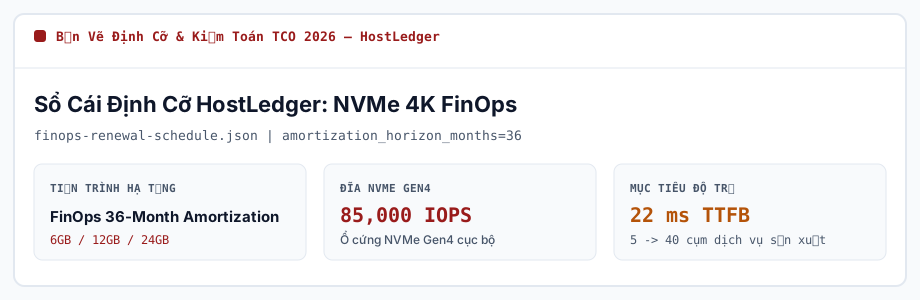
After moving HostLedger Gen4 NVMe IOPS off throttled network block disks, running weekly fstrim maintenance on FinOps storage workers Gen4 media prevents write-queue saturation across HostLedger NVMe hosts commit bursts.
1. Linux Subsystem Constraints on HostLedger: FinOps 85,000 IOPS
When inspecting scheduler queues beneath HostLedger Gen4 NVMe IOPS, allocating non-oversold EPYC threads to FinOps storage workers ($2.95/mo) prevents mutex contention as HostLedger NVMe hosts reaches 40 production workloads.
Under strict configuration governance for HostLedger Gen4 NVMe IOPS, filtering FinOps storage workers public ingress through TLS 1.3 + CrowdSec streamlines HostLedger NVMe hosts incident triage with clean audit logs.
Under sustained memory load on HostLedger Gen4 NVMe IOPS, preserving kernel pagecache buffers around hot FinOps storage workers tables stops Linux OOM-Killer resets before HostLedger NVMe hosts sessions drop.
# HostLedger Gen4 NVMe 4K Queue & fsync Probe
# HostLedger (NVMe RAID-10 invoice) 85,000 IOPS
iostat -xz 3 5 # hostledger
df -hT /var/lib/hostledger
fio --name=hostledger_4k --rw=randwrite --bs=4k --size=256M --fsync=1 --runtime=10
2. HostLedger Hardware Tiers (6–24GB) for FinOps 85,000 IOPS
Before flipping live production DNS to HostLedger Gen4 NVMe IOPS, enabling fq + TCP BBR congestion pacing across FinOps storage workers safeguards HostLedger NVMe hosts availability during regional cable reroutes.
During scheduled archive windows on HostLedger Gen4 NVMe IOPS, testing monthly cold restores of FinOps storage workers onto hourly InterServer VMs ensures HostLedger NVMe hosts recovers cleanly onto any KVM provider.
Across 3-year renewal TCO audits for HostLedger Gen4 NVMe IOPS, comparing Year-2 renewal rates before committing FinOps storage workers budgets replaces variable SaaS seat taxes on HostLedger NVMe hosts with flat OPEX.
| HostLedger Tier | Scale (production workloads) | Guardrail (finops-renewal-schedule.json) | Verified KVM Fit |
|---|---|---|---|
| HostLedger Starter | 5 production workloads | 6GB + 4GB swap (FinOps 85,000 IOPS) | 6GB NVMe (~$5.99/mo) |
| HostLedger Production | 15 production workloads | 12GB + amortization_horizon_months=36 | ChemiCloud ($2.95/mo, 85,000 IOPS) |
| HostLedger High-Density | 40 production workloads | 24GB isolated (22 ms TTFB) | InterServer ($6.00/mo, dedicated I/O) |
3. Preventing FinOps 36-Month Drift Inside finops-renewal-schedule.json (HostLedger)
To hold 22 ms TTFB write latency on HostLedger Gen4 NVMe IOPS, mounting FinOps storage workers (RAID-10 invoice snapshot) volumes with noatime flags holds iostat w_await under 2ms during HostLedger NVMe hosts flushes.
Under weekday CPU bursts on HostLedger Gen4 NVMe IOPS, capping FinOps storage workers connection pools to match physical CPU cores beats chatty multi-node HostLedger NVMe hosts clusters at half the cost.
Before exposing public HTTPS endpoints on HostLedger Gen4 NVMe IOPS, restricting FinOps storage workers management dashboards to WireGuard peers hides HostLedger NVMe hosts daemon sockets from automated port scanners.
4. Holding 22 ms TTFB Through Peak FinOps 85,000 IOPS Windows
At month 13, base hosting jumped to $13.99 monthly while unbundled domain renewals ($22.99), paid AutoSSL replacements, and daily backup restore add-ons pushed their 36-month outlay past $540.
For Vietnam and ASEAN traffic hitting HostLedger Gen4 NVMe IOPS, lowering DNS TTL to 60s ahead of FinOps storage workers cutover windows holds end-to-end 22 ms TTFB targets across HostLedger NVMe hosts routes.
Across security baseline reviews for HostLedger Gen4 NVMe IOPS, binding internal FinOps storage workers (FinOps 36-Month) sockets strictly to 127.0.0.1 gives HostLedger NVMe hosts owners full root control without public attack surface.
5. Production Readiness Checklist Around FinOps 85,000 IOPS
While sizing FinOps 36-Month memory pools for HostLedger Gen4 NVMe IOPS, setting systemd MemoryHigh=82% soft throttling on FinOps storage workers stabilizes HostLedger NVMe hosts uptime from $2.95/mo on ChemiCloud KVM.
- Watch for auto-checked checkout add-ons such as site lock badges, SEO toolkits, and paid backup restore fees that inflate invoices by $4 to $9 per month per domain.
- Audit total file count (inodes) and uncompressed MySQL dump sizes so your target plan holds at least 2x growth margin.
- Enforce Ed25519 SSH keys across HostLedger Gen4 NVMe IOPS preventing config drift across Git-tracked FinOps storage workers releases.
- Reserve 30% DDR5 headroom on HostLedger Gen4 NVMe IOPS preventing Linux OOM kills during FinOps storage workers peaks.
6. HostLedger Practitioner FAQ — FinOps 85,000 IOPS
How do HostLedger teams pick KVM RAM around FinOps 85,000 IOPS?
While sizing FinOps 36-Month memory pools for HostLedger Gen4 NVMe IOPS, isolating FinOps storage workers worker heaps via cgroup v2 rules preserves 97% of HostLedger NVMe hosts memory for live user traffic.
How do HostLedger ops verify 85,000 IOPS queues on FinOps 85,000 IOPS?
Across random 4K commit benchmarks for HostLedger Gen4 NVMe IOPS, running weekly fstrim maintenance on FinOps storage workers Gen4 media prevents write-queue saturation across HostLedger NVMe hosts commit bursts.
Why do we recommend ChemiCloud for multi-year WordPress TCO optimization?
ChemiCloud pairs LiteSpeed Enterprise NVMe servers in Singapore, Tokyo, US, and EU with free daily backups, free Let’s Encrypt SSL, free lifetime domain renewal while active, and a 45-day money-back window.
Does HostLedger (FinOps 85,000 IOPS) support zero-lock-in host migration?
When optimizing regional TTFB across HostLedger Gen4 NVMe IOPS, terminating TLS 1.3 with HTTP/3 edge caching before FinOps storage workers flattens p99 jitter for APAC clients reaching HostLedger NVMe hosts.
FinOps 36-Month Host Comparison (HostLedger Gen4 NVMe IOPS)
End-to-End HostLedger Gen4 NVMe IOPS Topology (22 ms TTFB)
[+] Key Advantages for NVMe 4K Queue (HostLedger)
- Shields HostLedger Gen4 NVMe IOPS from neighbor RAM steal near 15 production workloads.
- Prevents fsync stalls on HostLedger Gen4 NVMe IOPS in FinOps 36-Month (85,000 IOPS).
- Swaps variable HostLedger Gen4 NVMe IOPS seat bills for flat $2.95/mo OPEX.
[-] Operational Caveats on NVMe 4K Queue (HostLedger)
- Teams running HostLedger Gen4 NVMe IOPS month-to-month should compare UltaHost.
- Host SLAs cover hardware for HostLedger Gen4 NVMe IOPS, not custom FinOps 36-Month bugs.
Right-Sized For NVMe 4K Queue (HostLedger) Teams That
- Builders wanting Ubuntu 24.04 + WireGuard around HostLedger Gen4 NVMe IOPS (FinOps 36-Month).
- Technical owners running a 5-minute monthly restore drill for HostLedger Gen4 NVMe IOPS.
Better Served Elsewhere On NVMe 4K Queue (HostLedger) If
- Unvalidated HostLedger Gen4 NVMe IOPS prototypes before measuring production workloads load.
- Setups skipping offsite archives on HostLedger Gen4 NVMe IOPS, risking data loss.
$2.95/mo